

On Wednesday, I attended the SCSP AI+ Robotics summit in Washington DC, organized by the Special Competitive Studies Project, a non-partisan think tank founded by ex-Google CEO Eric Schmidt in 2021.
The event’s motivation could be summarized in one chart:
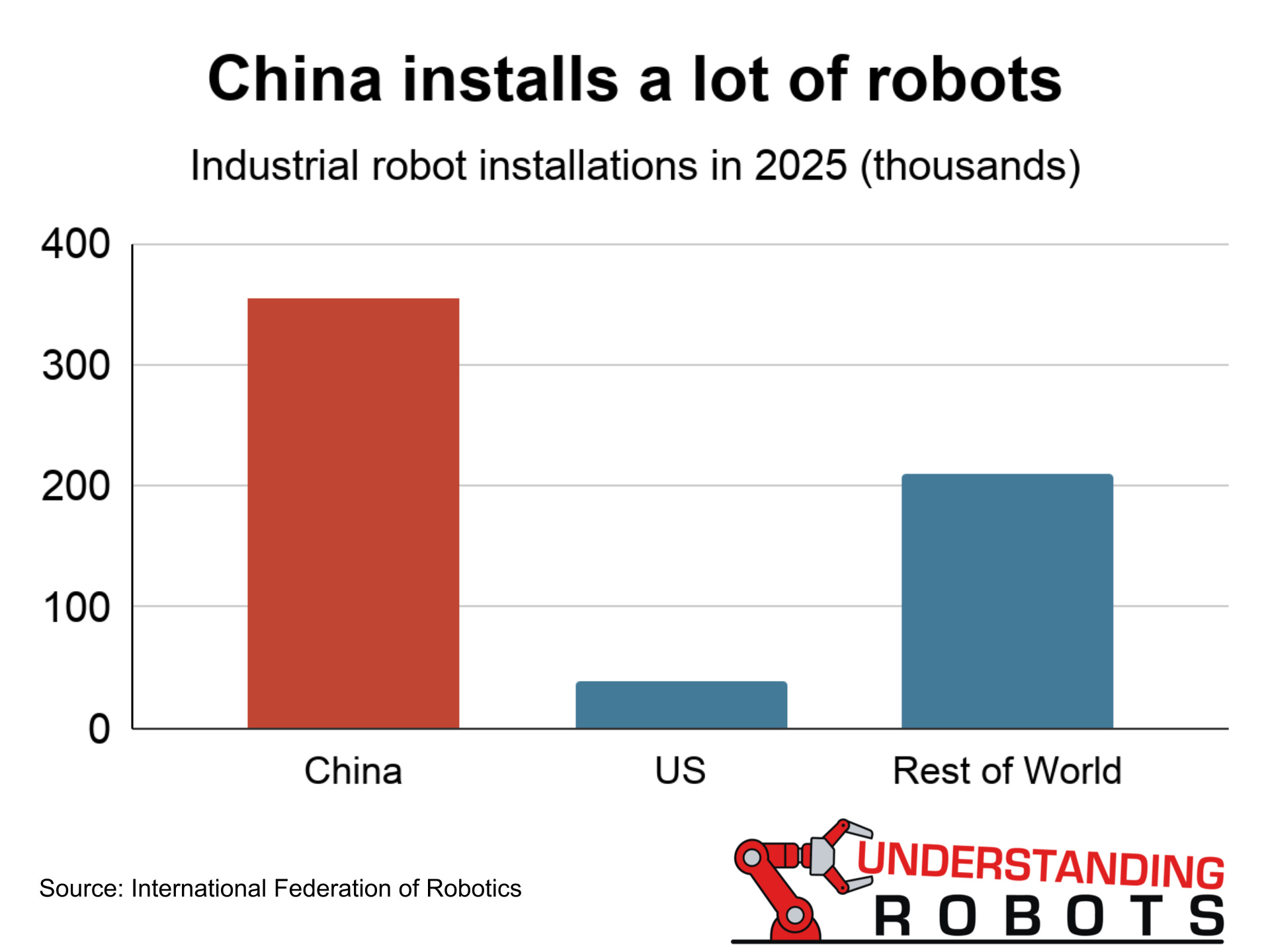
In 2025, about 354,000 industrial robots were installed in China, according to the International Federation of Robotics. This is over nine times as many as in the US, and more than the rest of the world combined. The majority of industrial robots installed in China in 2025 were made by Chinese companies.
While these numbers only cover industrial robots, the numbers are if anything more lopsided in newer categories of robots. In 2023, Chinese companies made almost 90% of the collaborative robots (cobots) shipped within the country — and over 97% of the humanoids shipped across the world in the first half of 2026.
This has provoked fears that Chinese industry could gain an increasing edge over America in the coming years. As SCSP argued in an interim report released the day before the conference, “Physical AI at scale will define the next industrial era, and the United States is not on a trajectory to lead it.”
So the one-day conference assembled tens of speakers across industry, academia, and politics to focus on how the US might respond. Here’s some of what I learned.
1. “Defensive versus offensive measures”
Recently, the most prominent US actions in robotics have been “defensive,” said Jenn Wall in the first panel. Wall is the general counsel of Google’s robotics software company Intrinsic.
What she means is that US policymakers have been more focused on keeping foreign robots out of the US market than promoting the growth of the US robotics industry. In July, for example, the Federal Communications Commission (FCC) added new mobile robots (like quadrupeds and humanoids) made outside the US to its Covered List, meaning that they cannot be imported into the US without an exemption from the Department of Defense. (Existing robots are not affected.) Tariffs make it more expensive to source robot components from China.
Wall thought that the US needed to find “the right mix of defensive versus offensive measures.” The SCSP event focused heavily on the latter.
This may be in part because many of the companies participating in the event would benefit from “offensive” policies like tax incentives or state-funded worker training programs. But it was also an admission of weakness: robotics looks likely to take off in China regardless of US policies.
The “race discussion” has a very different flavor in robotics compared to AI. In AI, the US holds significant leverage over Chinese companies — especially around access to compute, so policymakers debate how much to slow Chinese progress. With robotics, in contrast, discussions tend to focus on how to make the US more competitive.1
2. The flywheel problem
In the same panel, Agility Robotics CTO Pras Velagapudi was asked whether the US was too focused on defensive measures. Velagapudi responded, “the single most important factor in advancing robots is getting robots out there to have practice doing it?”
Velagapudi, like many of the other speakers, believes that robotics deployment creates a “flywheel.” The more robots a company deploys, the better it can improve its product and lower costs, which in turn leads to more deployments.2
This flywheel has arguably started for legged robots in China. In June, SemiAnalysis argued that Unitree is running exactly this positive feedback loop to create the cheapest quadrupeds and humanoids possible — and it might eventually dominate the market. Unitree’s Chinese competitors also have pilot deployments in factories and in stores.
This flywheel is much less far along in the US. But how to “grease that flywheel,” as Velagapudi put it, is still somewhat of an open question.
3. Jobs, jobs, jobs
Beyond deployment, perhaps the biggest focus on Wednesday was on human jobs. Specifically, on whether robots would put humans out of work.
This is an old concern. Jeff Burnstein, the president of the Association for Advancing Automation (A3), told me that he’s been asked about it “all the time, for forty years.”
But Burnstein argued that robots and automation increase jobs, rather than removing them. “We have charts that show whenever robot sales have gone up in America, unemployment has gone down.” That isn’t just correlation, he thinks. “When companies invest in robots, they also win new business and they invest in people.”
This argument is a variant of the Jevons paradox, the observation that as production grows more efficient, the total resources used can increase if lower prices unlock a large increase in demand. Most of the speakers agreed that this applied to manufacturing labor, sometimes adding a geopolitical twist: if manufacturing in America gets cheap enough because of robots, US market share could increase dramatically. “We’re not competitive today,” said Standard Bots CEO Evan Beard on a panel on scaling. “If we get competitive, then we could bring back a lot of manufacturing, and we could have a lot more jobs.”
In the AI world, many people speculate about robots getting so good that they completely replace human labor. No one at Wednesday’s conference seemed to believe this was likely — or perhaps no one wanted to say so publicly because of the political consequences.
4. Make robot technicians cool again
Roboticists have a second (standard) argument against the job loss point: the blue-collar labor shortage.
“It’s not like we’re throwing people out of work. The real issue is we can’t find people to do some of these jobs, especially the dull, dirty, dangerous ones,” Burnstein said.
Several speakers referenced a projection that there may be up to 1.9 million unfilled vacancies in manufacturing by 2033.3 This was taken as a key motivation to push more robots into manufacturing.
But the lack of skilled manufacturing labor is mirrored by a lack of skilled robot technicians to deal with the robots in the factories. No one cited specific numbers, but several speakers made a concerted effort to make that work sound cool.
“You can go to high school, you can get a two-year community college degree and you can go program a robot and be making like $75,000 a year,” said FANUC America CEO Mike Cicco. “We tell that story quite a bit that there’s a really good life to be had, a blue-collar life to be had.”
One thing that may make finding workers easier is that robots are getting much more straightforward. Standard Bots, for instance, on Thursday released a platform which lets factory employees program robots using an iPad app without needing experience with coding or robots.
Still, finding enough people to integrate and install robots seems like a major challenge.
5. The unclear role of allies
One place where the US might find the talent to jumpstart its manufacturing and robotics is from allies. Yet their role in the summit was quite unclear.
The event explicitly focused on how to increase America’s industrial capacity, rather than its network of allies. Sen. Ted Budd (R-NC), who co-chaired SCSP’s report commission, said in an introductory video, “I’m focused on a simple question: how do we turn America’s leadership in artificial intelligence into American industrial strength?”
Some panelists did acknowledge the importance of ally support. “Unless we work with allied nations, it is a big risk to us. If that country wants to prevent America from growing, they can,” said Cicco, who heads the American subsidiary of a Japanese company.
But recent American robotics policy has sometimes cut against cooperation. The FCC’s recent restrictions on robot imports applied to all foreign countries, even allies. As Charlie Mlcek, a legislative assistant for Rep. Bob Latta (R-OH), put it on a panel, it treats “Canada and China similarly.”
While Mlcek said that there are efforts in Congress to exempt NATO allies, there may be structural barriers to too much cooperation.
Reva Goujon, a director at the Rhodium Group, pointed out to me that one of China’s biggest advantages in robotics hardware is the concentration of component suppliers into a very small geographic area in Shenzhen. This allows Chinese robotics companies to iterate very quickly — if they need a new type of part, they can drive over to a supplier, make a request, and have the new part within a couple of hours.
We won’t be able to replicate that type of concentrated innovation in the United States if the robotics supply chain is spread across the entire network of allies, however. So American policymakers may want to onshore as much robot component manufacturing as possible — without alienating allies.
6. DC doesn’t have enough robots
Throughout the whole day, I only saw two robots. One was Boston Dynamics’ robot dog Spot, demonstrated on stage by Brendan Schulman, the company’s vice president of policy and government relations. The other was a modified version of Spot for welding owned by Path Robotics.
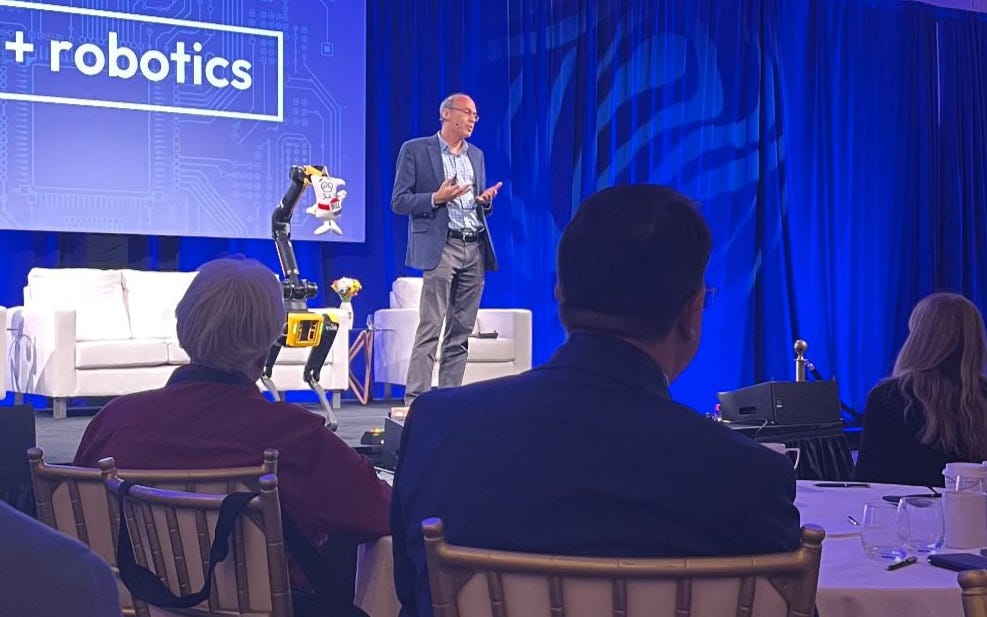
Schulman’s demo was fairly basic by my lights: he had the robot dog walk up some stairs, navigate over some boxes, pick up an object, and do a little dance. Still, a substantial proportion of the audience pulled out their phones to record it. I got the sense that it was the first time that many people had seen a legged robot like Spot.
It’s much easier to see robots in action in San Francisco — or major Chinese cities — than it is in DC. I wonder if this makes it more difficult for policymakers to understand the current state of the art.
7. Robot preemption might be the next policy fight
Throughout the day, speakers called for a national robotics strategy. American robotics strategy is arrayed across several federal departments, and there’s no one individual or institution directly responsible for increasing the amount of American robotics deployment. One of the key takeaways from the SCSP report was that America needs to coordinate its effort better.
This focus on centralization may lead to a second fight: whether to preempt state and county laws around robotics. “This is going to be the debate when it comes to physical AI — what is the balance between state and local versus federal,” Mlcek said in his panel.
Preemption has been in the news a lot over the past year and a half as some Republicans have repeatedly tried and failed to prevent states from regulating AI on their own. This has polarized some people skeptical of AI away from preemption as a policy tool.
Yet compared to AI, robotics preemption might have a stronger case. As we’ve seen with autonomous vehicles, there are many existing laws that need to be changed to allow for the broad deployment of robotics. A patchwork of state regulations might significantly slow robotics development and adoption.
Given the labor concerns though, it may be even more difficult to pass a robotics preemption bill, even if it was less broad than earlier AI safety preemption efforts. We’ll see how the politics play out over the coming year or two.
I do find this a bit confusing though. The US has some leverage over Chinese robotics, as Nvidia’s edge chips are used very widely across the industry, including in China. Would limits on these chips slow down Chinese robot progress? I don’t think this is necessarily a good idea, but I am a little surprised I didn’t hear any discussion of it on Wednesday.
Some speakers framed this flywheel in terms of data collection. Modern general-purpose robot models require a lot of physical data, which is currently difficult to obtain. Many hope that deployments will create real-world data at scale, which will improve future iterations of the model. This is a plausible theory — I’ve written about it before, but some roboticists disagree. As the researcher Chris Paxton wrote, “most robotics deployments are fundamentally not scalable, requiring large, specialized support teams and large amounts of resources to maintain, and the data that these deployments produce is almost certainly less valuable than you think it is.” However, the broader idea of a flywheel, where early deployments help jumpstart the market, seems much more solid to me.
Though Susan Helper, an economist at Case Western Reserve, poked a hole in the number by analogizing it to buying a car. “I’d really love to have a Mercedes. But I really would like to pay less than $10,000 for it. If I can’t find a $10,000 brand new Mercedes, do I have a Mercedes shortage or do I have a willingness to pay shortage?”
I too felt like there was a lack of robot demonstrations. I get to see boxing robots at CES, but all we got was a dog and they didn’t even make it flip. Need more stunts.
Interesting report, thanks. How would you characterize government interest in the conference? Aside from Ted Budd's intro video, were any other government speakers or active attendees?