

Two weeks ago, I went up to the seventh floor of the New Museum in Manhattan to watch the New York-based startup Tuesday Labs show off its new “gentleman-in-training,” Voxel. It was unlike any other robot demo I’ve ever seen, because Tuesday Labs focused more on the robot’s personality than its current capabilities.
“We will soon have robots in our homes,” said CEO Rosalind Shinkle. “The question really quickly becomes not what they will do, but how they will do it.”
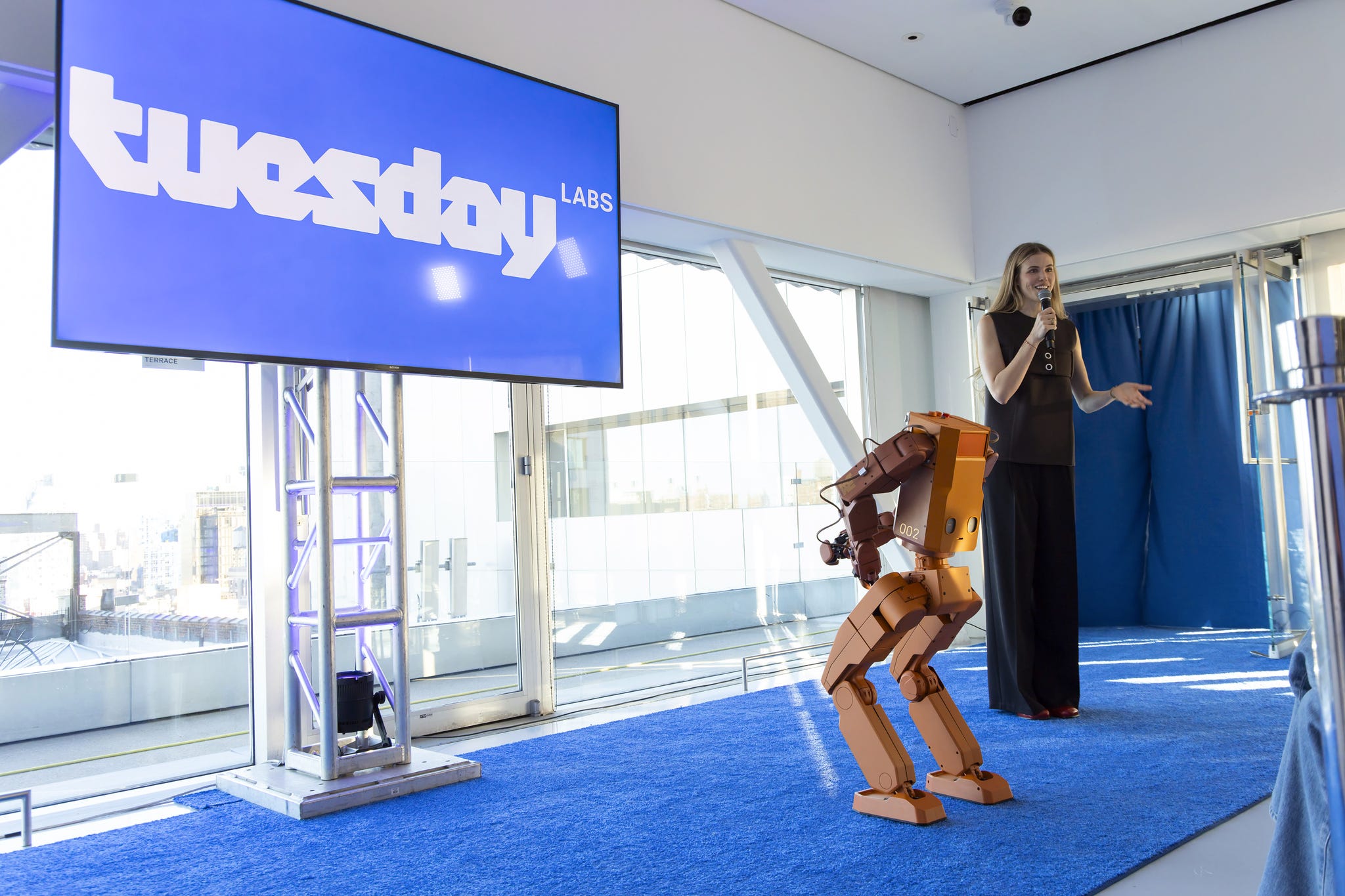
Tuesday Labs is betting that making a home robot that people want to buy requires giving that robot a strong character. So the company has hired ex-Pixar animators to flesh out Voxel’s personality.
Voxel was the star of the show. As Shinkle was wrapping up her remarks, Voxel ambled around the stage charming the audience. It’s not a tall robot, standing at maybe three and a half feet. Its playful and exaggerated motions were reminiscent of WALL-E. After the talk was over, Voxel posed for pictures with attendees.
There’s no question that Voxel is charming. But it’s not clear whether customers are going to want to pay $20,000 for Voxel. Because so far, the company hasn’t demonstrated the robot doing much — if any — useful work.
How Voxel’s character was made
At times, the presentation bordered on the philosophical. The company refers to Voxel with he/him pronouns and passed out a 50-page book to attendees titled “Etiquette in the Age of Robots,” which includes whimsical rules for living with a home robot. (Sample suggestion: if you’d like to please the robot, “drop a sock in the hallway.”)
The company explained how it crafted Voxel’s personality using tricks derived from both animation and robotics.
Animation expertise was supplied in part by Alonso Martinez, who worked for 11 years at Pixar. He described the company’s process. The team started by deciding what the robot cares about deeply: a perfectionist drive to make spaces clean. Once they had that core, Martinez used the shape of the robot to communicate character: curves signal friendliness, while a large forehead gives it a “youthful feel.”
The company’s head of machine learning, Nikhil Bakshi, said Tuesday Labs used a robotics technique — reinforcement learning — to train the robot to behave in a cute way. Most humanoid robots today are trained to walk via large-scale reinforcement learning in simulation, as I described in a September piece for Understanding AI.
The goal at many companies is to approximate a human gait, so they train the robot to mimic human reference data. Voxel, however, was trained to mimic reference movements sketched out by on-staff animators — things like wiggling the arms in a cute way or making eye contact.
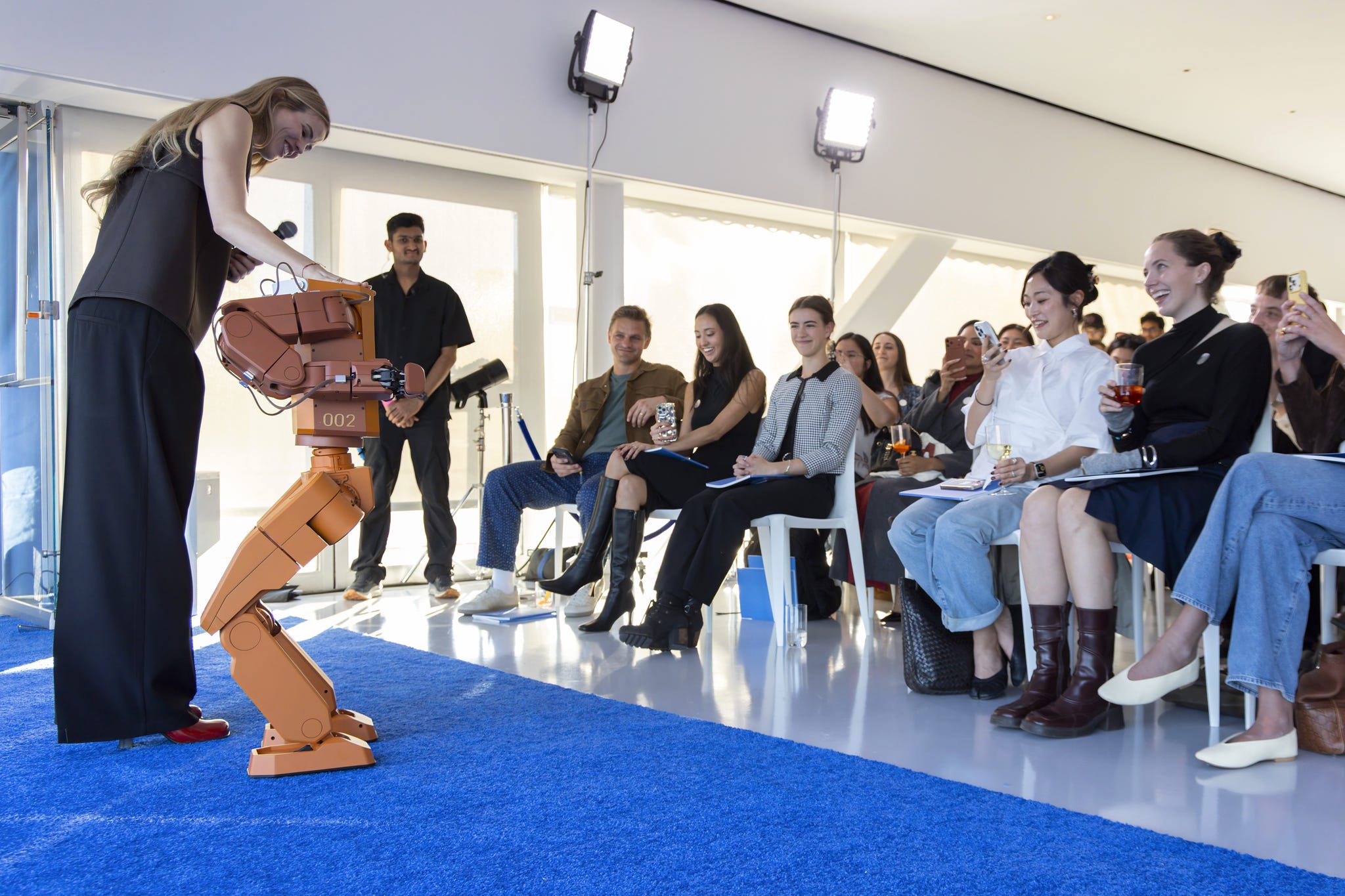
When Shinkle brought the robot out onto the stage, the crowd audibly “awwed” as one might with a puppy. Aside from a slightly annoying whirring sound, Voxel exuded a spunky attitude appropriate for an elementary-schooler-sized robot.
Demonstrating capabilities is less clear
Shinkle promised that by the time the robot was sent to the first customers, Voxel would be able to do four things:
“Home reset,” where the robot returns the living space to some preset standard every day while the person is at work.
Help find a lost item by telling the person where it last saw that item.
Retrieve a named item.
Tend plants — one of the Voxel promotional videos included it watering a plant.
However, the event barely focused on Voxel’s capabilities at all. Presenters didn’t explain the company’s technical strategy to train Voxel on these tasks. The company is apparently planning to follow standard industry techniques for non-personality aspects of the robot.
“The biggest thing we want to do is create a character-driven robot,” said Paul Vizzio, Tuesday Labs’ hardware lead, in a promotional video. “The quickest way for us to do that is use the most proven technology at least on the robotics side there is and add our character development on top of that.”
The current prototype of Voxel is a modified version of a Unitree G1 robot — perhaps the most popular humanoid robot in the world today. And the reinforcement learning approach to teach Voxel to move around is pretty standard for the industry.
Reaching broad-based capability, however, especially around manipulation in unstructured settings, is still very much an open research question. There’s the risk that Tuesday Labs builds a robot that’s charming but useless.
When I asked Martinez if Tuesday Labs was putting the cart before the horse, he said that character was a long-term bet the company was making. “Personality is not going to be solved in two years,” he told me.
We’ll see if robotics capabilities can be solved sooner. The company aims to start shipping its first robots to customers in 2028.
personality first, usefulness later is close to what UBTech is testing here. its U1 companion humanoid took 13,361 orders at ¥119,800 (~$17k), but on refundable ¥3,000 deposits, and only 1,500–2,000 are expected to ship this year. is Tuesday taking deposits too?
Disagree. Machines should not be imbued with human characteristics like personality. Doing so risks porting human shortcomings into machines, making them just a copy of the model person used as the template that becomes a person residing behind a metallic front.